

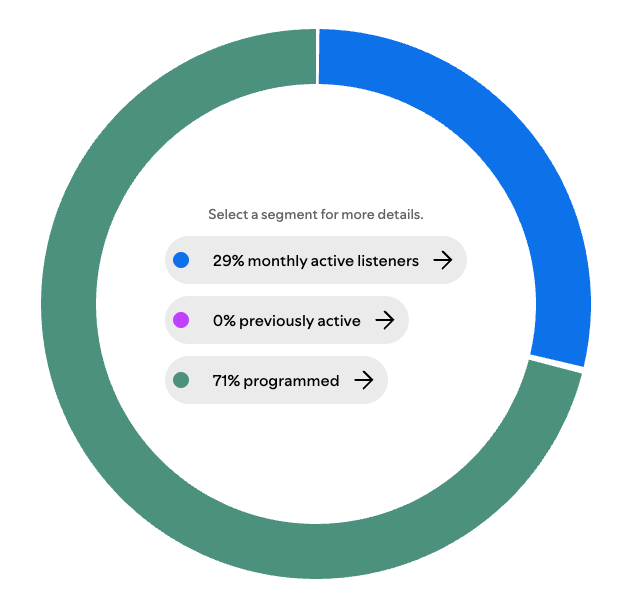
The chart above shows listener sources for our single “Blow”
by The Dead Air Saints.
At first glance, it may not look dramatic. But for an independent band releasing music without major-label support, these numbers represent one of the most important milestones in the life of a new release.
Understanding the Chart
Spotify groups listeners into several categories. In this example, the key numbers are:
- 71% programmed listeners
- 29% monthly active listeners
- 0% previously active listeners
Programmed Listeners: 71%
This is the big one.
A programmed listener is someone Spotify introduced to the song through its recommendation systems.
These listeners may discover a track through Spotify Radio, Artist Radio, Autoplay, personalized mixes, algorithmic recommendations, or other Spotify-generated listening experiences.
In our case, 71% of listeners came from Spotify’s recommendation engine rather than from our own audience.
That means the platform is beginning to trust the song enough to show it to listeners who have never heard of The Dead Air Saints before.
For an independent artist, that is a significant development.
Monthly Active Listeners: 29%
These listeners actively sought out the music.
They may have clicked through from social media, followed a link from our website, found the song through friends, visited our artist profile directly, or already been familiar with the band.
This audience is incredibly important because they provide the initial momentum that helps a release gain traction.
Without real listeners engaging with a song, the algorithm has very little data to work with.
Previously Active Listeners: 0%
This category tracks people who have already been listening to the artist.
Because The Dead Air Saints are a new project, this number is currently very small.
In many ways, that is encouraging. It suggests that much of the audience discovering “Blow” is completely new to the band.
How Does Spotify Decide?
Nobody outside Spotify knows the exact formula.
However, most independent artists believe several listener signals matter:
- Streams
- Saves
- Playlist adds
- Repeat listens
- Completion rate
- Follows
- Listener engagement
When enough listeners respond positively, Spotify may expand distribution to larger audiences.
Think of it as a series of trust tests. A song performs well with one group of listeners. Spotify shows it to a slightly larger group. If those listeners respond positively too, the cycle can continue.
Why We’re Encouraged
As an independent band from Pittsburgh, we are realistic about how difficult it is to gain attention in today’s music landscape.
The encouraging part of this chart is not just the size of the audience. It is the direction.
When nearly three-quarters of listeners are arriving through Spotify’s recommendation systems, it suggests the platform is beginning to find listeners who connect with the music.
That is the first step toward sustainable growth.
What Fans Can Do To Help
If you enjoy a song from an independent artist, a few simple actions can make a huge difference:
- Follow the artist on Spotify
- Save the song to your library
- Add it to a playlist
- Share it with friends
- Listen more than once
These actions help platforms understand that real people value the music.
And that, ultimately, is what helps great songs find new listeners.